Across the United States, up to one-third of the colonies kept by commercial/backyard beekeepers collapse each year, according to government surveys. We have been losing bees to a mysterious condition known as colony collapse disorder or CCD. Exactly what’s causing CCD, among the early suspects: parasites, climate change, and infections are among the main 3 to deliver a triple whammy for CCD.
Parasites: The bloodsucking Varroa (Vuh ROW uh) mite. Scientists have found evidence that these mites latch onto the back of an adult worker bee. Once inside the hive, it detaches itself and enters the cell of new baby bees to be born, thus weakening the whole hive and causing the collapse.
Climate Change/deforestation: A changing climate can bring droughts or flooding that affect the availability of flowers, a bees life source, this makes bees more vulnerable than ever. Also, with the expansion of human development, wild bees have been losing their natural habitats as the land transitions into industrial agriculture.
Infections/pollution: Another explanation for the collapse of so many colonies is that the bees are forgetting their way home (again due to pesticides). In most cases, bees come in contact with only tiny amounts of these poisons. Normally these exposures would be too small to kill them. Still, even tiny amounts will move throughout a bee’s body. About one-third will reach its brain, and that may be enough to confuse the bee. Bees travel up to 5 miles for water/food sources, and with all the pollution, they are losing their trail sent back to the colony, and would not survive.
Supporting Data
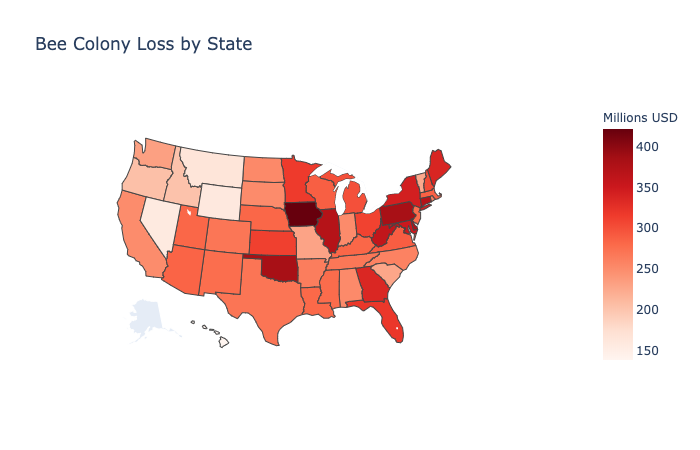
As a new student learning data scientist at Lambda School, this is my first project, as I am passionate about saving the bees. I got my data from data.world, and it includes statistical data from 2010–2017. The data provides information on (by state) the loss of bee colonies (by percent) annually, the number of known colonies, the number of known beekeepers, and the percentage of beekeepers exclusive to the state.
Bee Colonies had a 20% increase in 2012/13 (first figure below), Why did this happen? Was the weather pattern better for them in 2012? But since then, bee colonies are on the decline each year after. Beekeeping is also on the decline (second chart below). I understand this as I am a beekeeper myself, and it is way more involved and more expensive than one would think.
What I found to be the most interesting, according to this data, is bee colony loss was highest in 2014/15 but is getting better in 2016 and 2017 (third chart below). Is this because we know the varroa mite is killing the bees, and we as beekeepers are now treating them, thus the less colony loss? Are people becoming more informed and doing their part by planting more flowers? All the things I hope to find out more in the future.
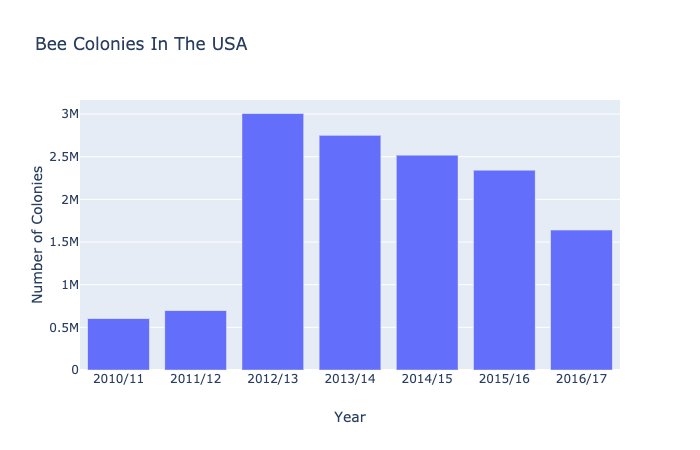
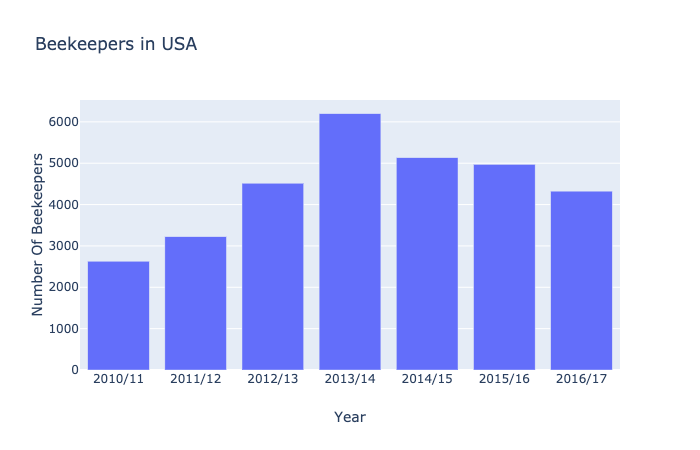
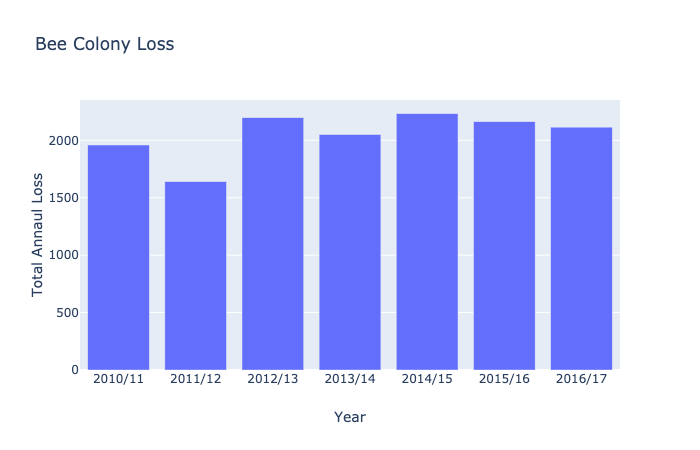
To answer the title question: Are honeybees on the collapse? With this particular data set, the conclusion is - Although, colony loss is getting better (maybe due to treating for parasites and heathier hives), colonies are in fact on the decline.
Here is my colab notebook.
5 Ways to help
1.)Plant more flowers: Researchers suggest planting native flowers as this helps ensure more pollinators will be around the next year.
2.)Let your lawn get back to its roots: Put down the weed-eater! Bees don’t have any use for that perfectly manicured garden. They prefer something similar to their natural habitat - a meadow. Think about letting a portion of your yard go back to its roots. Allow dandelions and clover to grow again (two of bees’ favorite delicacies). Not only will you spend less time mowing your lawn, but the bees will also thank you for it. If you have an HOA, bring this article to them so you won’t get a ticket.
3.)Just say NO to pesticides/herbicides: Are you spraying those dandelions? That poison gets to the bees and will make them sick. Dandelions are a great first food source in the spring, so let them grow and go do something more fun with your time!
4.)Don’t be scared: Bees want nothing to do with you! They just want to find food to survive. If anything, they think you are a flower so take that as a compliment! Just stay still and they will soon leave you alone.
5.)Bee informed: There are a lot of misconceptions going around about bees and how important they are to the world we live in - it’s time to educate yourself!